Monthly Archives: June 2011
Estudio 6 Producto Industrial UniAndes
 Este post contiene algunas imágenes de los proyectos desarrollados por los estudiantes del departamento de diseño dentro de la asignatura Estudio 6 Producto Industrial 2011 1.
Industrial and strategic design as key of social innovation in humanitarian crises.
MAGAZINE (DIGITAL): Industrial and strategic design as key of social innovation in humanitarian crises. Case: earthquake on 12th January 2010 in Haiti on http://www.designemartigos.com.br/
This document is intended to explain one of the many ways in which industrial and strategic designers have the ability to formulate strategic plans ―working together with governments, NGO’s and private corporations― that includes the proposal of specific programs and the development of projects (designing products and services) thus giving innovative solutions for humanitarian crisis.
Considering that the general overview after January 12 -2010 about Haiti, the students who were following the course called “Design and organization” within the Industrial Design Department at the Universidad Nacional de Colombia in Palmira, had mapped the context that makes possible the formulation of the plan “Haiti 2010” raised through three programs (housing, education, and transport) in nine projects interpreted by three-students working groups and that may be implemented in the short, medium and long term responding to the Development Goals of the New Millennium made by the Organization of the United Nations.
The text concludes with the presentations of the three projects-conclusions, as case studies. Each one of them in a particular term and in a different program, exposing concrete solutions to this humanitarian crisis in particular, showing the role of design in these circumstances.
—
Este documento tiene por objeto explicar una de las muchas formas en la que los diseñadores industriales y estratégicos tienen la capacidad -en un trabajo conjunto con gobiernos, ONGs4 y empresas privadas- de formular planes estratégicos, que incluyen el planteamiento de programas específicos y el desarrollo de proyectos (diseñando productos-servicios) dando así soluciones innovadoras para las crisis humanitarias.
Teniendo en cuenta el panorama general en Haití después del 12 de enero de 2010, los estudiantes de la asignatura “Diseño y Organización” del Departamento de Diseño Industrial de la Universidad Nacional de Colombia-Sede Palmira realizaron un mapeo del contexto que hace posible la formulación del Plan “Haití 2010” planteado a través de tres programas (vivienda, educación y transporte), en nueve proyectos interpretados por grupos de trabajo de tres estudiantes y que podrán ser implementados en el corto, mediano y largo plazo respondiendo a los Objetivos de Desarrollo del Nuevo Milenio formulados por la Organización de la Naciones Unidas. El texto concluye con la presentación de tres proyectos-conclusiones, a modo de casos de estudio. Cada uno de ellos en un plazo y programa distintos, que exponen soluciones concretas a esta crisis humanitaria en particular demostrando el rol del diseño en estas coyunturas.
Leia mais: http://www.designemartigos.com.br/el-diseno-industrial-en-las-crisis-humanitarias/#ixzz3BVkarP00
Under Creative Commons License: Attribution
You can download the entire paper here: http://www.designemartigos.com.br/el-diseno-industrial-en-las-crisis-humanitarias/
Javier Ricardo Mejia Sarmiento
Resultado Obtenidos en 2da Velada de diseño e Innovación Social Rio Nima 2011.
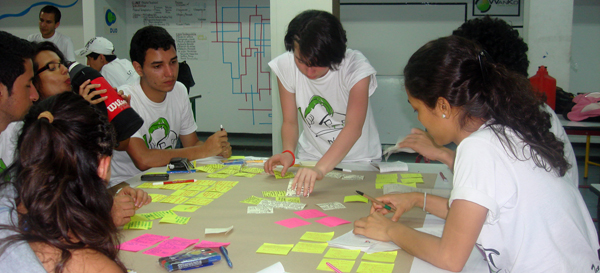 Al finalizar la segunda velada de diseño e innovación social Rio Nima (http://jrms.pktweb.com/?p=1522) se obtuvo un banco de ocho proyectos basados en la metodología Human Centered Design HCD (http://jrms.pktweb.com/?p=483) de IDEO (http://www.ideo.com/). Los proyectos hacen evidente el trabajo del diseñador como facilitador en procesos colectivos de co-creación para contribuir a la resolución de los problemas identificados con la comunidad del Rio Nima.
Lo que se presenta a continuación es el resumen y presentación de su trabajo, que puede descargarse del link que aparece al final de las imágenes.
Los resultados están divididos en dos, que corresponden a las herramientas empleadas por los estudiantes para comunicar los proyectos:
– Una línea de tiempo (http://jrms.pktweb.com/?p=382) que describe el diseño estratégico de un programa (conjunto de proyectos) alrededor de un tema en particular (educación, salud, vivienda, transporte, etc.).
Esta línea de tiempo está dividida en plazos; el corto plazo (2011) dedicado a desarrollar proyectos con acciones perentorias que deben ejecutarse inmediatamente; mediano plazo (hasta el 2020) con proyectos más complejos, que de manera congruente con los del corto plazo mejorarán sustancialmente el bienestar de la comunidad y el escenario futuro en el largo plazo (2030) para consolidar, mediante proyectos macro, los objativos perseguidos por los programas planteados.
Este ejercicio se desarrolló basándose en los conceptos relacionados con la planeación estratégica o por escenarios.
– Una infografía (http://jrms.pktweb.com/?p=1192) que muestra el diseño estratégico en un caso de estudio seleccionado por el grupo como el más representativo, es decir el que genera mayor impacto en la comunidad.
Los grupos se dieron a la tarea de seleccionar dentro de la línea de tiempo el proyecto más importante para luego detallarlo mediante una infografía que representa el concepto general del negocio, el producto, el sistema de productos o servicios diseñados durante los cuatro días; demostrando como interactuarían los actores del proyecto (grupos dentro de la comunidad, empresas, organizaciones, el estado, etc.) en el contexto particular de acción.
Mobility at the first and last mile of the IPT in a European Megacity
After a human-centered design process, crucial conditions were identified in the changing process of development and growing of the European Megacities. These situations created the scenario for the author to determine the design opportunities to contribute to the sustainable development. Three steps were completed following a methodology from the TUDelft called Vision in Product Design. A literature research with the intention to define the mission statement of the system and the vehicle and a set of design-oriented user research toolkits were used. The final result is ITO which is a family of fully low floor, modular and lightweight cyber cars, minibusses and buses with electric propulsion for a flexible range of passengers. Using existing infrastructure, this set of cars can fill the gap between private vehicles and public city buses offering an uplifting journey in a comfortable vehicle that is part of an efficient and flexible i.p.t. The interior design answers the entire passenger’s needs and expectations creating a unique experience thanks to different and sophisticated communication systems.
