Blog
#Design4Enterprises Diseño para las empresas, una herramienta para el desarrollo de las MIPYME #futurethroughdesign

La Comisión Europea presenta el proyecto Diseño para las Empresas (#Design4Enterprises). Este proyecto consiste en un conjunto de cursos para apoyar la innovación impulsada/liderada por el diseño en las MIPYME. Estos cursos, que son totalmente gratuitos, se orientan a: (i) MIPYME europeas, que quieran mejorar sus habilidades de gestión del diseño, y a (ii) negocios intermediarios, tales como Cámaras de Comercio, que se convertirán en futuros formadores para otras MIPYME. Este programa de formación se centran en el diseño como el elemento clave en las estrategias para el desarrollo de las MIPYME en el mercado global.
Tengo el gusto de ser el consultor experto para España en temas como “innovación guiada por diseño” y “diseño estratégico”. Adicionalmente soy el coordinador para toda la Comunidad Europea del módulo “diseño de conceptos futuros”, temas central de mi proyecto doctoral en TUDelft.
Saber más sobre el programa http://www.designforenterprises.eu/
Más información sobre el módulo “diseño de conceptos futuros” acá:
5th CIM -Creativity and Innovation Management- Community Workshop

I had the opportunity to present the paper “Design of Vision Concepts to explore the future: nature, context and design techniques” during the 5th CIM -Creativity and Innovation Management- Community Workshop, which was held in the campus of the University of Twente, Enschede, The Netherlands on 1 September 2015.
Here the video of Teresa Amabile from Harvard Business School who welcomes the participants of the workshop.
More information about the event here
#CIMjournal
Javier Ricardo Mejia Sarmiento
Context & Conceptualisation – Conference 2014 – Call for Papers – Track 9 #futurethroughdesign
Editor: Ricardo Mejia / J.R.MejiaSarmiento@tudelft.nl
Availability: Feel free to email me, an extra workshop is going to be arranged. Our challenge below this lines.
Visioning the future built environment
Workshop visioning the future built environment as part of Climate-KIC Summer School
- Problem owner: Climate-KIC
- Process owners:
- Facilitators: Susie Brand-de Groot, Jan-Willem Hoftijzer, and Ricardo Mejia (ID Studio Lab, Delft University of Technology)
- Participants: Ph.D.’s, postdocs, Master students and driven professional.
Challenge
Complex topics like urbanization and energy management need special commitment in unifying a common view, especially due to the amount of parties co-designing and co-producing products and services for its development. This requires collaboration across departments and partnering companies and is connected to problems of communication and concerted action between partners. Different parties need to develop a joint understanding, goals, and agenda.
To create a set of alternative futures -to unify the vision of stakeholders- that cover many possibilities the technique called “scenario thinking” as a way of dealing with ambiguity and uncertainty is used from a strategic perspective.
In a ten-hours-long workshop the attendees, guided by a group of facilitators, will explore diverse future scenarios of buildings and then will develop different kind of solutions regarding new low carbon technologies using a variety of creative techniques.
Seminario de Creatividad e Innovación / EAFIT 2013
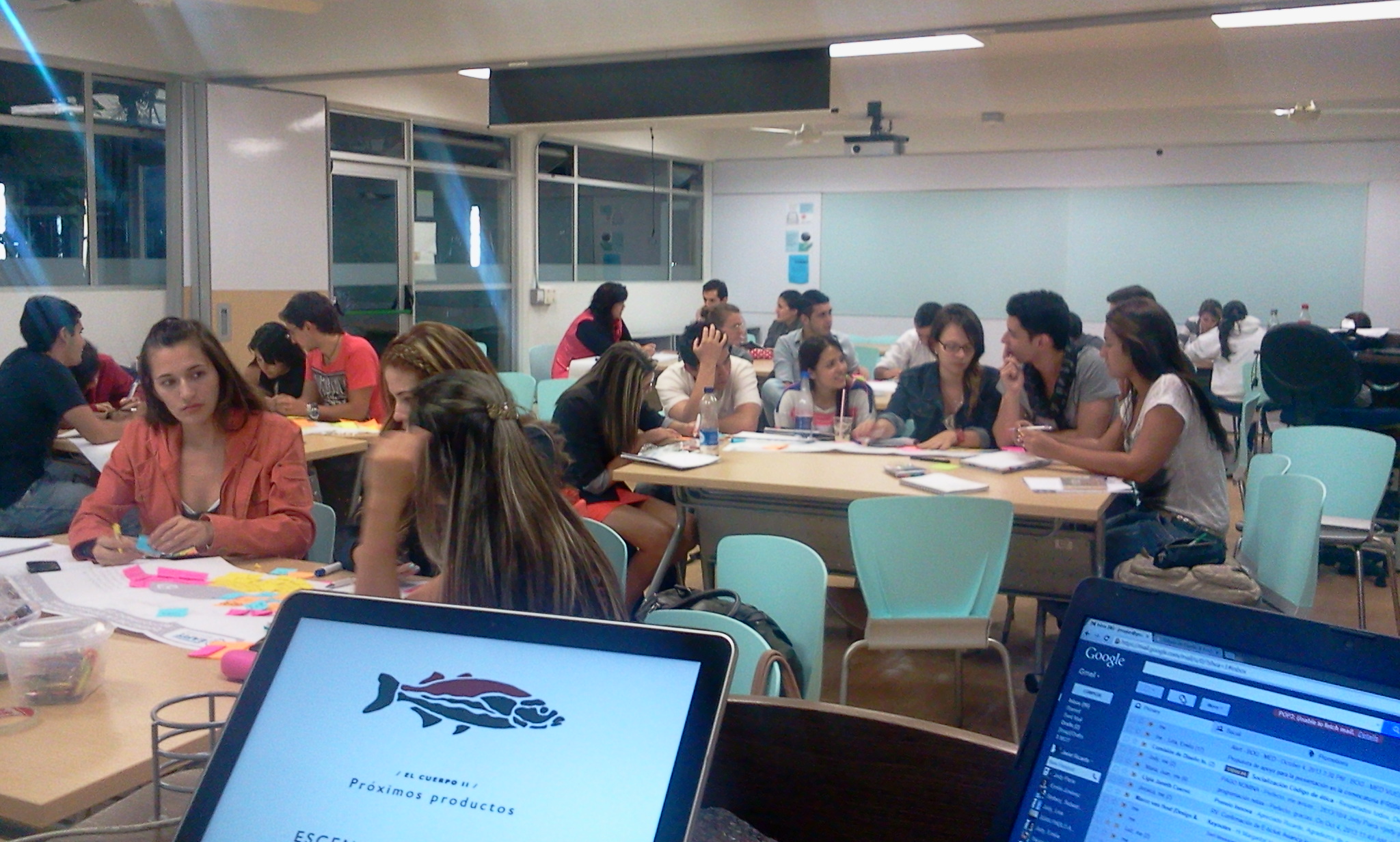
PRESENTACIÓN GENERAL DEL SEMINARIO
“El proceso creativo ha sido el mecanismo determinante de la supervivencia de los seres humanos. Al no estar dotados fisiológicamente para enfrentar las adversas condiciones ambientales o de otros predadores, la recursividad creativa asociada al uso, fabricación y manejo de instrumentos y la construcción de un lenguaje y por supuesto un pensamiento, se convirtieron en el motor del desarrollo neuronal del hombre pre-moderno. Si se viese la historia del hombre en perspectiva, se notaría inmediatamente que el desarrollo tecnológico, científico, económico y social a través de los tiempos y lugares, se debe en buena medida, a esta notable capacidad: la creatividad.
Los sistemas educativos se han centrado en los procesos de memorización de la información, el uso de procesos lógicos, secuenciales y algorítmicos, lo cuáles son importantes, pero descuidan la capacidad de reflexión e improvisación que tiene la mente humana, base de otros modelos de inteligencia, propuestos por Howard Gardner.
